
SEO Guide
How to Handle and Respond to Negative Google Reviews
Response templates for negative reviews, when to flag fake reviews, and how reputation affects local rankings.
You know how one bad comment online can feel like a disaster for a local shop. The truth is, mastering how to respond to negative google reviews actually builds a stronger reputation.
We see this shift every day at Adam SEO. A thoughtful reply turns a frustrated buyer into a loyal advocate.
Negative reviews are inevitable for any business serving real customers over time. The question is not whether you will receive them, but how you handle them when they arrive.
We have watched businesses transform complaints into highly effective marketing tools. Done badly, a poor response amplifies the damage and signals poor management to Google’s algorithm.
This guide gives you a working framework.
We will cover when to respond, what to say, and how to escalate fake reviews. You will also learn exactly how reputation interacts with Map Pack ranking.
Why response matters more than the review itself
Responding to complaints matters because future customers base their buying decisions on your public accountability. A well-crafted negative review response directly protects your revenue and local search visibility.
We rely heavily on recent data to guide our local clients. The 2026 BrightLocal Local Consumer Review Survey found that 90.6% of consumers always read reviews before making a purchase. This proves that your reply is for the silent audience of future buyers.
Future customers reading your reviews are not just reading the complaints. They are watching how you handle pressure. A three-star rating with a professional, accountable response from the owner often reassures buyers more than a profile with zero complaints. It shows the business solves problems instead of hiding.
Google reads this behaviour as a major ranking signal too. We track these changes closely through industry studies. The 2026 Whitespark Local Search Ranking Factors report assigns a massive 20% of local ranking weight directly to review signals. Businesses that manage their profiles actively correlate with better Map Pack ranking over time. The effort to set up consistent habits is small, but the benefit compounds for years.
Here are three reasons your response drives local success:
- Trust Building: It demonstrates accountability to the 90.6% of consumers reading reviews.
- Algorithmic Value: Search engines reward active profile management.
- Damage Control: A professional reply diffuses tension immediately.
The three-step response framework
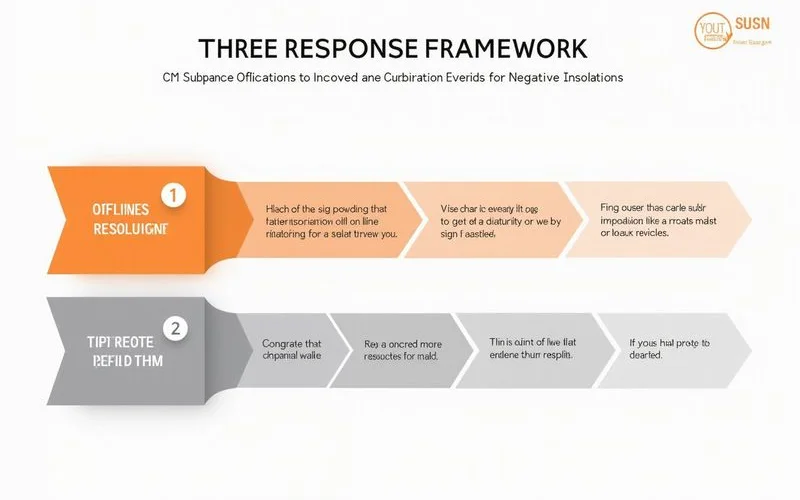
The best approach to handling complaints is a consistent, structured reply that de-escalates the situation. Every effective response follows a strict three-step framework: acknowledge, address, and move the conversation offline.
We constantly see businesses fail by arguing in public. The Service Recovery Paradox is a well-documented psychological principle showing that a customer who experiences a problem, which is then successfully resolved, often becomes more loyal than a customer who never had a problem. This framework aims to trigger that exact paradox.
1. Acknowledge. Name what the reviewer is upset about immediately. We advise clients to avoid defending themselves first or minimising the issue. A simple “I am sorry your experience with our service did not meet your expectations” diffuses the defensive stance most upset customers expect.
2. Address. Briefly explain what happened or what you understand from their account. Stating something like, “Looking at our records, I can see there was a scheduling miscommunication on the day you were expecting our technician,” is highly effective. This proves you took the complaint seriously enough to investigate the facts.
3. Offline resolution. Invite the conversation off Google and onto a direct channel. We recommend shifting the chat to WhatsApp Business or a direct phone line, as these are highly preferred by Malaysian consumers. Saying “Please reach me directly at hello@adam-seo.com or 016-699 9393” signals to future readers that you fix problems privately.
A complete response should remain between 60 and 120 words. Anything longer reads as defensive. Anything shorter feels dismissive.
Template responses
Having pre-written structures ensures you reply quickly without letting emotions dictate your words. You should adapt these templates to your specific brand tone while keeping the core message intact.
We always remind business owners that Google limits review responses to 4,000 characters. Keeping your replies concise is a much safer strategy. While AI tools like Gemini can help draft ideas, using generic, canned text violates Google’s 2026 guidelines for authentic engagement.
Here is a comparison of how to handle different scenarios:
| Situation | Example Response | Why It Works |
|---|---|---|
| Partial Responsibility | ”Thank you for sharing this feedback. I am sorry your experience fell short. Looking into what happened, I see [brief honest summary]. I want to make this right. Please reach me at [contact] so I can personally resolve this.” | Shows accountability while gently clarifying facts. |
| Full Responsibility | ”You are right, and I am sorry. We missed the mark here. Please reach me directly at [contact] so I can make this right and learn from what went wrong. Thank you for the feedback.” | Complete transparency disarms further anger. |
| Factual Disagreement | ”Thank you for the feedback. Our records show a different sequence of events, but I prefer to discuss this directly rather than debate it publicly. Please reach me at [contact] so we can work through it.” | Maintains professionalism without conceding false claims. |
| Wrong Business / Mix-up | ”Hi [name]. Looking through our records, I do not see a service matching these details. This might be intended for another business. Please reach me at [contact] so we can clarify.” | Protects reputation while offering help. |
When to flag a review
You should only escalate reviews that explicitly violate Google’s content policies. Successful flags lead to complete removal, protecting your profile from malicious attacks.
We have seen a sharp rise in sophisticated spam attacks recently. Google’s April 2026 Fake Engagement policy update uses Gemini-powered AI to detect fake reviews Google profiles attract. If Google detects a sudden spike in fake engagement, they can pause new reviews and even display a public warning banner on your profile. This makes proactive flagging critical.
Google allows you to flag specific types of violations. Cases worth reporting include:
- Off-topic content: The text discusses something unrelated to your specific business.
- Fake engagement: Coordinated attacks from competitors or fake accounts.
- Conflict of interest: A submission from a current employee, former staff member, or direct competitor.
- Hate speech: Any discriminatory or abusive language.
Submit the flag directly through the Google Business Profile interface. We find that generic flags are often automatically rejected by the system. For a better chance of success, submit a formal removal request using the GBP appeals tool and include specific case IDs. Google’s manual review process is slow, but well-documented policy violations are usually removed.
Reviews you cannot remove
Genuine complaints from real customers cannot be deleted, regardless of how much you dislike them. The correct approach is to respond professionally rather than wasting time trying to force a removal.
We frequently receive questions about legal action regarding bad ratings. While the Malaysian Communications and Multimedia Commission (MCMC) has strict regulations regarding online defamation, a standard negative opinion about a bad meal or late service does not legally qualify for removal. You must learn to manage these public critiques.
Ignoring them carries a massive financial penalty. Recent 2026 BrightLocal data shows that a single unanswered negative review can cost a business up to 30 potential customers. The three-step framework provided above is your best defense. A well-handled complaint actually supports your business by signalling strong accountability to anyone reading your profile.
Reputation and Map Pack ranking
Your overall review profile health acts as a major signal for local search algorithms. Consistent, high-quality engagement directly influences where you appear in the Map Pack.
We prioritise active review management for every campaign. According to 2026 consumer data, 92% of users require at least a 4-star average before they will even consider visiting a local business. A sudden drop in ratings can destroy your foot traffic overnight.
Review profile health affects your local ranking in four specific ways:
- Average rating: Businesses maintaining above 4.5 stars consistently outrank lower-rated competitors.
- Review velocity: Earning a steady stream of fresh feedback over time outranks sudden, unnatural spikes in activity.
- Response rate: Engaging with over 90% of your reviews shows better algorithmic signals than sporadic replies.
- Keyword content: Customers mentioning your specific services naturally reinforces semantic relevance.
A single complaint that drops your average from 5.0 to 4.9 is barely noticeable. Accumulating a pattern of unanswered criticism is highly damaging. Active management remains your strongest competitive advantage.
Setting up a response cadence
Establishing a strict daily routine is the only way to manage your online reputation effectively. A structured response cadence prevents bad feedback from lingering and causing algorithmic damage.
We advise setting up automated alerts using tools like Hootsuite or GoHighLevel to catch new mentions instantly. Relying on manual checks often leads to missed opportunities and delayed responses.
For most local businesses, two specific habits work incredibly well:
- The Daily Check: Dedicating two minutes each morning to glance at new notifications catches issues fast.
- The 48-Hour SLA: Responding to both positive and negative comments within two business days builds immense customer trust.
Faster replies show up positively in algorithmic signals. If you cannot maintain this internally, our Local SEO retainers include review management as part of the service. The required effort is small per interaction but delivers high-leverage results when executed consistently across years.
Conclusion: How to respond to negative google reviews
Mastering how to respond to negative google reviews is a fundamental skill for any growing business. We know that facing public criticism is uncomfortable. A proactive approach turns those challenging moments into powerful displays of your commitment to customer satisfaction. Start by auditing your current profile today. Reply to any lingering comments using the frameworks provided, and watch how quickly consumer trust begins to shift in your favour.