
SEO Guide
E-commerce SEO vs Google Shopping Ads
Cost-per-sale, margin impact, and how to combine organic and paid for online stores. Decision framework for Malaysian e-commerce.
From what we have seen managing campaigns across Malaysia, the 2026 cost-per-click spikes are forcing brands to rethink their digital budgets entirely. That dividing line for success is now defined by how well you balance paid and organic traffic.
We know that Shopping Ads are uniquely effective for transactional product searches. The buyer sees the product image, price, and store name directly in the results.
The trade-offs against organic e-commerce SEO are real, but they differ significantly from the trade-offs found in standard service businesses.
Let us look at the data, what it actually means for your margins, and explore a practical hybrid approach that outperforms picking a single channel.
What each channel does best
Google Shopping Ads capture immediate transactional intent with visual product listings, while e-commerce SEO builds long-term visibility across the entire buyer journey. Since Adam Yong founded our agency in 2011, we have built every campaign on the premise that traffic alone is meaningless without tangible business impact. Both channels serve distinct functions in a modern digital strategy. Our team consistently views these two avenues as complementary rather than competitive.
Google Shopping Ads are paid product listings appearing at the top of Google search for product-intent queries. A 2026 report by Uproas shows these ads maintain a strong 1.91% average conversion rate globally. Shoppers can compare offers from multiple stores side by side, making this format highly effective for users already in a buying mindset.
E-commerce SEO ranks your product, category, and supporting content pages in the organic results below the ads. A recent 2026 industry analysis revealed that only 3.2% of shopping queries trigger an AI overview, meaning standard blue links still dominate commercial searches. The buyer often sees these results deeper into the consideration funnel for queries like “best [product category]” or “[product] reviews”.
Conversions are typically lower per click but become virtually free per conversion once the page ranks. The strengths and weaknesses are distinct enough that the channels almost always work better together than separately.
| Feature | Google Shopping Ads | E-commerce SEO |
|---|---|---|
| Primary Intent | Transactional (Ready to buy) | Informational & Commercial |
| Average Conversion Rate | 1.91% (2026 Uproas Data) | Varies, high for long-tail queries |
| Initial Cost | High (Pay per click) | High (Agency/Retainer fees) |
| Long-Term Cost | Remains constant or increases | Drops significantly over time |
Cost per sale, honestly
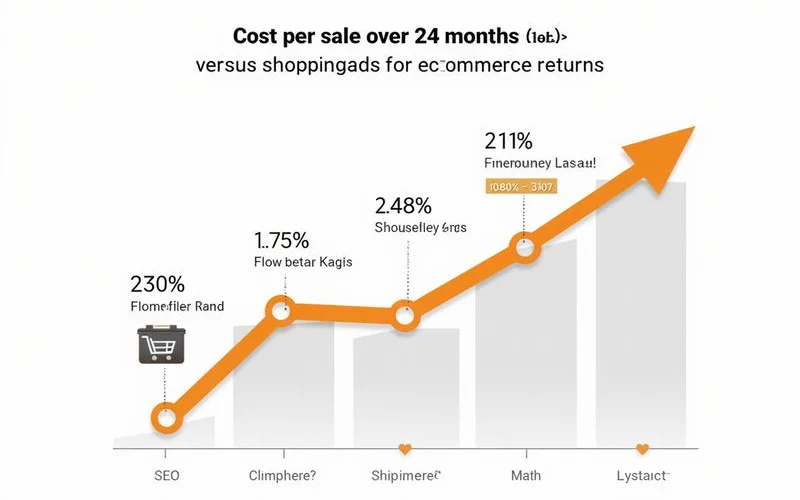
E-commerce SEO has a high upfront cost with lower initial returns, but it eventually drives the cost per sale down to 2-5% of the order value. Google Shopping Ads deliver immediate sales, but ad spend continually eats into 8-15% of your gross margins. We always advise clients to look at the 24-month horizon when evaluating these metrics.
For a typical Malaysian e-commerce store with a 25-35% gross margin, Google Shopping cost per sale (CPS) usually lands at 8-15% of order value. A RM 200 product sale via Shopping Ads costs RM 16-30 in ad spend, which eats into the gross margin meaningfully. Data from MediaPlus Digital in 2026 indicates average Search CPCs in Malaysia can range from RM 1.20 to RM 5.50, depending on the niche.
Pro-Tip: The median breakeven point for e-commerce SEO sits around month nine. Do not panic if your organic cost per acquisition looks terrible in month four, as this is a normal part of the maturity curve.
Our experience shows e-commerce SEO requires significant upfront investment in months 1-6 because the retainer cost is high while organic revenue is still ramping. The cost per sale during this period is usually much higher than ads. A 2026 upGrowth study notes that the median breakeven point for e-commerce SEO sits around month nine.
By month 9-12, organic revenue typically grows enough that the blended cost per sale drops below the ads equivalent. By year two, organic CPS on commercial queries is typically 2-5% of order value, making it vastly cheaper than ads. The upGrowth data also highlights that by month 18, businesses often see an SEO return on investment of around 317%.
The CPS curves cross somewhere between month 9 and month 18 depending on competition and execution quality. Every additional month of organic ranking after this crossover widens the margin advantage.
Margin impact
Organic SEO aggressively protects your profit margins at scale, saving businesses millions in ad costs over a multi-year period. Shopping Ads scale revenue quickly but maintain a fixed cost percentage that limits long-term profitability. We see this dynamic play out constantly as local brands scale their operations.
The Malaysian e-commerce market is projected to hit RM 180 billion by 2026, according to a recent CLEARomni report. Capturing a share of that market is great, but retaining the profit is where organic search wins decisively.
Consider a store doing RM 500,000 per month in revenue:
- 100% Shopping Ads (10% CPS): RM 50,000 monthly in ad cost.
- 100% Organic SEO (Mature Asset): RM 5,000-15,000 monthly in maintenance retainer.
- Blended (60% organic, 40% paid): RM 20,000-25,000 in combined cost.
Our financial modeling clearly demonstrates how the margin saved compounds rapidly. Saving RM 30,000 per month over five years means RM 1.8 million stays with the business instead of going to Google. Mature e-commerce brands tend to skew heavily toward organic over time for exactly this reason, while emerging brands lean on paid ads for speed.
When Shopping Ads lead
Shopping Ads should take the lead when you need immediate transaction data or have highly seasonal inventory. This channel acts as a fast-acting revenue engine for businesses that cannot wait for organic traction. We frequently deploy Shopping Ads for product lines that require rapid market validation.
You should use Shopping Ads as your primary channel when you encounter these situations:
- You launched recently and need immediate transaction data to inform inventory decisions.
- You sell fast-moving, trend-driven items like consumer electronics or seasonal Raya fashion, where SEO ramp-up is simply too slow.
- You compete in highly transactional categories with little research stage, such as a direct search to “buy iPhone 15”.
- You have a clear margin advantage that absorbs the rising cost per click.
- You are validating new product lines before committing to long-term content investment.
- Your inventory is short-life and cannot wait 6-12 months for an organic presence to mature.
When SEO leads
E-commerce SEO should lead when your products require extensive research or your margins cannot absorb rising click costs. Long-term content assets capture buyers who are still comparing options and building trust. Our most successful B2B clients rely heavily on this organic approach to educate their buyers.
A 2026 industry analysis highlights that some competitive Malaysian service and retail niches now face CPCs hitting RM10 to RM15. You must pivot to SEO when paying for every click becomes mathematically unsustainable.
Use e-commerce SEO as primary when:
- You sell in categories with strong commercial-investigation queries like “best [category]”, reviews, and detailed comparisons.
- Your margins cannot sustain rising CPC costs at scale.
- You have time and budget patience for a 6-12 month ramp-up period.
- You operate in a niche where competitor ad spend has driven up the cost per acquisition unsustainably.
- You sell complex or considered products, such as high-end home furnishings, where buyers research extensively before purchasing.
The hybrid strategy that wins
The most profitable e-commerce brands blend both channels, typically allocating around 70% of their long-term budget to SEO and 30% to highly targeted ads. This 70/30 split is a proven 2026 model for Malaysian SMEs looking to balance immediate cash flow with a sustainable digital moat. We have successfully implemented this structure across dozens of regional storefronts.
What Shopping Ads Cover
Paid campaigns are your precision tools for immediate capture. They excel at scooping up buyers who know exactly what they want right now.
- Transactional product queries with exact match intent (“buy [exact product]”).
- New product launches where waiting for organic indexing is too slow.
- Long-tail products that may never accumulate enough organic traffic individually to justify a dedicated SEO campaign.
- Remarketing to previous visitors to close abandoned carts.
What E-commerce SEO Covers
Organic search acts as your wide net, capturing users early in their journey and building undeniable brand authority.
- Commercial-investigation queries that compare options (“[brand A] vs [brand B]”).
- Category and collection landing pages that organize your inventory.
- Buyer-guide and how-to-choose content that smoothly funnels readers to product pages.
- Brand and category authority that compounds over time.
Our teams ensure the two channels share critical infrastructure. Schema markup helps both listings stand out. Clean product descriptions improve ad relevance and organic rankings. Customer reviews increase click-through rates across both mediums. The foundational work is rarely duplicate.
How to sequence the investment
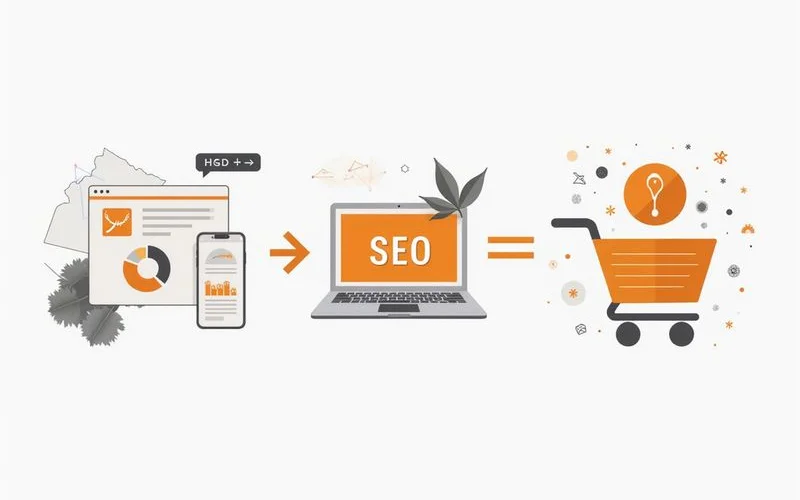
A smart investment sequence starts with heavy ad spend to gather data, followed by a gradual shift toward SEO-driven traffic. You use the immediate feedback from paid clicks to build a targeted, high-converting organic strategy. We guide clients through a specific timeline to ensure maximum resource efficiency.
For a store starting from scratch, the optimal timeline looks like this:
- Months 1-3: Run heavy Shopping Ads and Performance Max campaigns while building SEO foundations. This includes technical fixes, product page optimization, and implementing accurate schema markup. Use the initial ad data to identify exactly which queries actually convert into sales.
- Months 4-6: Begin your SEO content rollout based entirely on the high-converting queries your Shopping Ads validated. Maintain your ad spend at full capacity during this phase to keep revenue flowing.
- Months 7-12: Your organic traffic will start to build significant momentum. Start reducing your ad spend specifically on the queries where your organic pages are now ranking in the top three positions.
- Year 2+: Most of your product-intent traffic should now come from organic search, pushing your SEO ROI toward that 317% benchmark. Ads are then reserved strictly for new product launches, seasonal pushes, and highly specific queries that your SEO does not cover yet.
The shift from an ads-led model to a blended approach, and finally to an organic-led powerhouse, usually takes 18-30 months for serious brands. Your compounding cost advantage builds continuously the whole time.
Where to start if you are uncertain
If your store lacks historical conversion data, begin with paid channels to validate your product demand. Actionable data is the foundation of any successful scaling effort. Our initial assessments always look for this baseline information before recommending a massive content build.
If your store has less than 6 months of paid ad data, start with Shopping Ads to generate transactional data. You need to know what people will actually pay for.
If you have a year or more of ad data and clear knowledge of which products convert, our E-commerce SEO service can build the organic asset on top of that proven demand.
The discovery audit assesses your specific situation to recommend a realistic ramp. We analyze:
- Current channel mix and historical conversion data
- Competitive landscape for your specific product categories
- Profit margin structure to ensure sustainable scaling
Book an audit with us today to find the most profitable path forward for your digital storefront.